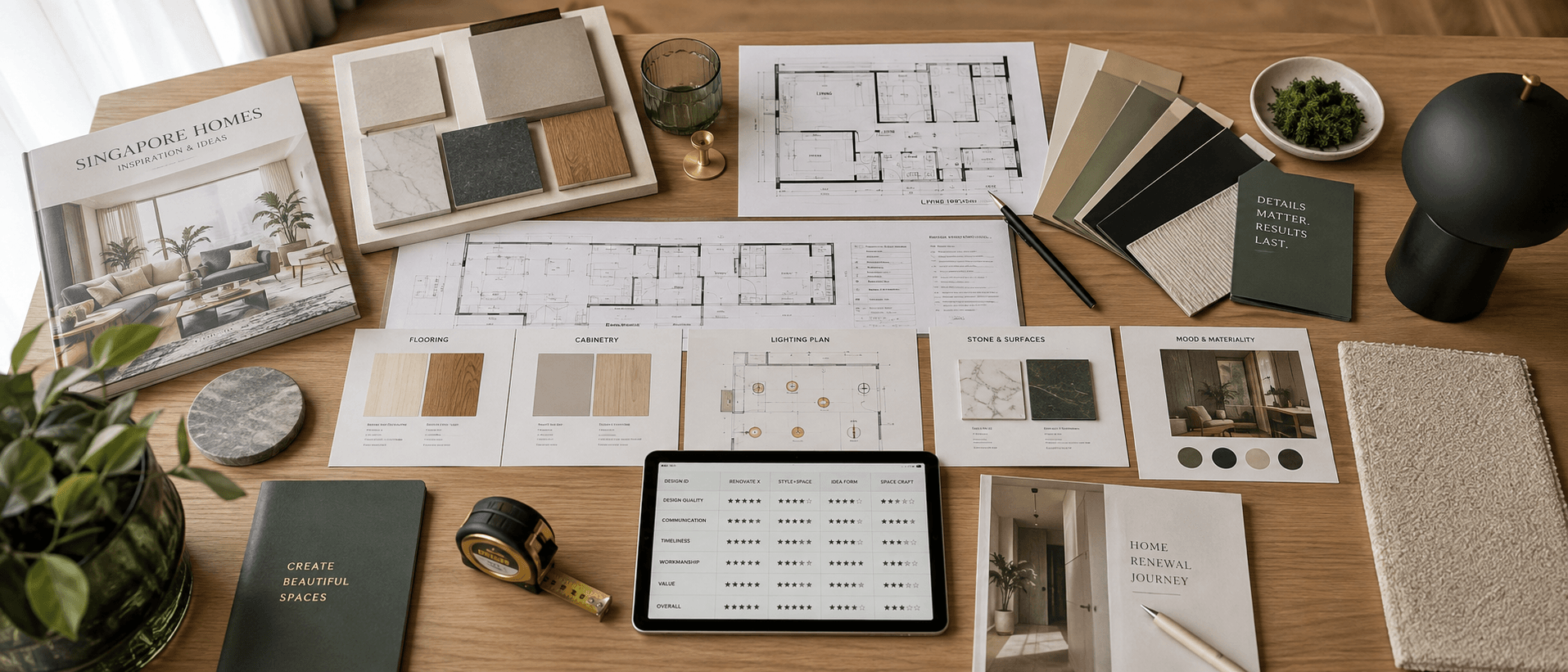
TLDR: The best interior design firms in Singapore in 2026 depend on project scope, renovation budget, design style, and required project management. Homeowners should compare portfolio quality, public review volume, quotation detail, renovation experience, and after-sales support. Established firms can suit full-home renovations, while smaller studios may provide more specialised design attention. Affordable interior design in Singapore requires a clearly defined scope because low design fees can exclude renovation, project management, or material costs. Homeowners should obtain itemised quotations and verify current ratings and review counts before signing a renovation contract.
The best interior design firms in Singapore in 2026 are the companies that match a homeowner’s renovation scope, budget, design preferences, and required level of project management; HDB renovation projects must also comply with HDB renovation requirements and applicable building rules. The comparison below covers 10 established interior design firms and studios, using portfolio strengths, service scope, public review signals, and suitability for different homeowner needs rather than treating one company as the best choice for every project.
What are the best interior design firms in Singapore?
The best interior design firms in Singapore include 9 Design, Design4Space, Eight Design, Todz’Terior, Swiss Interior, Interior Times, The Interior Lab, Dyel Design, 3D Innovations, and Happe Design Atelier.
Each firm has a different mix of design capability, renovation execution, pricing structure, project scale, and customer-service model. Homeowners should use this list as a shortlist, then compare current portfolios, public reviews, quotations, contract terms, and renovation availability before making an appointment.
The ranking is intended as a practical comparison rather than a guarantee of workmanship or project outcome. Public ratings and review counts change over time, and homeowners should verify the latest figures directly on the relevant review platform.
How do the top interior design firms in Singapore compare?
The comparison below shows the typical strengths and likely fit of 10 widely considered interior design firms in Singapore.
| Firm | Typical strengths | Suitable project types | Review and rating check | Budget positioning |
|---|---|---|---|---|
| 9 Design | Contemporary residential interiors, space planning, and coordinated renovation | HDB flats, condominiums, and landed homes | Verify the current Google rating and review count before appointing | Mid-range to premium |
| Design4Space | Full renovation coordination, practical layouts, and broad residential experience | HDB resale flats, BTO flats, and condominiums | Compare recent reviews with the relevant project type | Budget-conscious to mid-range |
| Eight Design | Modern residential concepts, detailed design presentation, and renovation management | Apartments and landed residential projects | Check current reviews for communication and defect rectification | Mid-range |
| Todz’Terior | Customised residential design, bold styling, and project coordination | HDB, condominium, and landed renovations | Review recent customer feedback and completed project photographs | Mid-range to premium |
| Swiss Interior | Functional layouts, renovation execution, and practical material selection | HDB and condominium renovations | Verify current rating, review volume, and renovation licence details where relevant | Budget-conscious to mid-range |
| Interior Times | Contemporary design, built-in carpentry planning, and residential renovation | New apartments, resale homes, and condominiums | Check whether recent reviews relate to projects similar to yours | Mid-range |
| The Interior Lab | Design-led interiors, styling, and complete renovation services | Condominiums, landed homes, and higher-specification renovations | Compare current reviews with portfolio and contract scope | Mid-range to premium |
| Dyel Design | Bespoke concepts, material coordination, and personalised design direction | Design-conscious homeowners and apartment renovations | Verify current review activity and after-sales comments | Mid-range to premium |
| 3D Innovations | Space-efficient layouts, 3D visualisation, and renovation planning | HDB flats, compact apartments, and first-home renovations | Check current ratings and reviews for budget control | Budget-conscious to mid-range |
| Happe Design Atelier | Boutique design direction, distinctive styling, and customised interiors | Homeowners seeking a more individual design approach | Review current portfolio consistency and project-management feedback | Mid-range to premium |
The table above is a starting point for comparison, not a live rating table. Google ratings, review counts, staff availability, project portfolios, and pricing can change, so homeowners should confirm current information before relying on a ranking.
Which interior design firm is best for an HDB renovation?
Design4Space, 9 Design, Swiss Interior, Eight Design, and 3D Innovations are practical starting points for homeowners planning an HDB renovation.
HDB homeowners should prioritise firms that understand common flat layouts, resale-unit defects, hacking restrictions, wet-area requirements, electrical planning, and built-in storage constraints. A suitable designer should also explain which renovation works require approval and which works must be completed by appropriately registered contractors.
HDB renovation quotations should separate design fees, demolition, masonry, electrical works, plumbing, carpentry, painting, appliances, furnishings, project management, and potential reinstatement costs. Itemised pricing gives homeowners a clearer basis for comparing firms than a single headline package price.
Which interior design firm is best for a condominium renovation?
The Interior Lab, Todz’Terior, Eight Design, Interior Times, and Dyel Design are suitable firms to consider for condominium projects that require stronger design coordination.
Condominium renovations require coordination with the management corporation, building management, approved working hours, lift protection rules, renovation deposits, contractor registration, and site access procedures. Homeowners should ask each firm how it handles management submissions, delivery restrictions, neighbour-sensitive works, and defect reporting.
A condominium designer should confirm whether the quotation includes management application costs, protection of common areas, disposal charges, permits, and attendance during inspections. These items affect the final renovation cost even when the design concept appears straightforward.
How should homeowners compare the best interior designer Singapore reviews?
Homeowners should compare review recency, review volume, project relevance, repeated complaints, and the firm’s response to negative feedback.
A high average rating with very few reviews does not provide the same evidence as a consistently strong rating supported by many recent renovation reviews. Homeowners should look for feedback covering quotation accuracy, designer communication, workmanship, handover quality, defect rectification, and adherence to agreed timelines.
Review analysis should also distinguish design reviews from renovation-execution reviews. A firm can produce attractive concepts while receiving weaker feedback about site supervision, carpentry defects, variation orders, or post-handover support.
The most useful review questions include:
- Did the final price remain close to the accepted quotation?
- Did the designer explain material specifications and exclusions?
- Did the renovation finish within the promised timeframe?
- Did the firm respond promptly to defects?
- Do the reviews describe a project similar to the homeowner’s property?
What makes an affordable interior design Singapore package genuinely affordable?
An affordable interior design Singapore package is genuinely affordable when the quoted scope, materials, labour, project management, and exclusions are clear before work begins.
Low entry prices can exclude carpentry, electrical works, hacking, plumbing, appliances, painting, design revisions, site supervision, delivery, disposal, and defect rectification. Homeowners should compare the total cost of completing the intended renovation rather than comparing only the design fee or promotional package price.
Budget-conscious homeowners can reduce costs by retaining usable flooring, limiting structural changes, choosing standard carpentry finishes, reducing custom-built storage, selecting readily available materials, and finalising the layout before construction. Cost reductions should not remove essential waterproofing, electrical safety, ventilation, or compliance work.
An affordable quotation should state the following items:
- Design and consultation fees
- Demolition and disposal
- Masonry and wet works
- Plumbing and electrical works
- Carpentry specifications and hardware
- Painting and finishing
- Appliances and lighting
- Project-management responsibilities
- Payment milestones
- Defect liability and warranty terms
- Exclusions and variation-order rates
What should homeowners check before appointing an interior design firm?
Homeowners should complete a documented comparison before paying a deposit or signing a renovation contract.
- Define the renovation brief. Record the property type, floor area, expected move-in date, preferred style, storage needs, must-have works, and maximum budget.
- Shortlist three to five firms. Select companies with recent work resembling the property’s layout, size, building type, and desired finish level.
- Review portfolios critically. Ask whether each photograph shows the firm’s completed work, a staged show unit, a concept rendering, or work delivered by another contractor.
- Request itemised quotations. Require separate prices for design, demolition, construction, carpentry, electrical work, plumbing, appliances, furnishings, permits, project management, and disposal.
- Compare material specifications. Check brands, grades, thicknesses, hardware types, waterproofing systems, paint products, glass specifications, and appliance allowances.
- Confirm renovation responsibility. Identify the person supervising the site, the party arranging approvals, the contractor performing the work, and the process for recording defects.
- Read the contract. Check payment milestones, cancellation terms, variation-order rules, delay provisions, warranty coverage, defect liability, ownership of drawings, and dispute procedures.
- Verify current public feedback. Check recent ratings and reviews, then ask for references or permission to view a completed project where practical.
- Confirm the timeline in writing. Require start dates, estimated completion dates, dependencies, long-lead items, and the consequences of homeowner or supplier delays.
- Select based on total fit. Choose the firm that provides the clearest scope, strongest relevant evidence, and most workable communication process rather than automatically choosing the lowest quote.
What questions should homeowners ask during an interior design consultation?
Homeowners should ask questions that expose scope, cost, supervision, materials, and post-handover responsibility.
Useful consultation questions include:
- Who will be the lead designer and site supervisor?
- How many active projects will the assigned designer manage?
- Which works are performed by employees and which works are subcontracted?
- What is included in the design fee?
- How many design revisions are included?
- Are 3D drawings and technical drawings included?
- Which renovation works are excluded from the quotation?
- What happens when actual site conditions differ from the design assumptions?
- How are variation orders approved and priced?
- Who handles HDB, condominium, or other building-management submissions?
- What is the expected renovation duration?
- What defect liability period applies after handover?
- How does the firm handle delays, defects, and unresolved disputes?
How much does an interior design firm cost in Singapore?
Interior design costs in Singapore vary according to property size, renovation scope, material specification, carpentry volume, and project-management requirements.
A simple design consultation costs less than a full-service package covering concept development, drawings, procurement, construction, site supervision, and handover. HDB resale renovations can also cost more than a light BTO renovation when the project includes demolition, rewiring, plumbing replacement, levelling, waterproofing, or extensive carpentry.
Homeowners should request a total-project estimate and a separate list of likely provisional sums. Provisional sums can change when the firm opens existing walls, checks concealed pipes, measures site conditions, or confirms material availability.
No firm should be compared solely by its advertised starting price. A lower initial price can become more expensive when excluded works, upgrades, variation orders, and additional supervision are added later.
What are the main risks when choosing an interior design firm?
The main risks are unclear scope, unrealistic timelines, incomplete quotations, weak site supervision, uncontrolled variation orders, and inadequate defect support.
An attractive portfolio does not prove that a firm will deliver the same quality on every project. Homeowners should evaluate operational evidence, including the clarity of the quotation, responsiveness during consultation, detail in technical drawings, material samples, site-supervision arrangements, and written warranty terms.
Unclear variation-order procedures create a significant budget risk. Homeowners should require written approval before additional work begins and should confirm whether the quoted price includes labour, materials, transport, disposal, and applicable taxes.
Timeline promises should also be treated carefully. Renovation duration can be affected by approval delays, material lead times, access restrictions, discovery of hidden defects, and changes requested after construction begins. A written programme is more useful than a verbal completion promise.
Which interior design firm is suitable for different homeowner priorities?
The most suitable firm depends on the homeowner’s primary priority rather than on a single universal ranking.
| Homeowner priority | Firms to compare first | What to verify |
|---|---|---|
| Affordable HDB renovation | Design4Space, Swiss Interior, 3D Innovations | Package exclusions, carpentry specifications, and variation-order rates |
| Full-service renovation management | 9 Design, Eight Design, Interior Times | Site-supervision frequency, contractor coordination, and handover process |
| Design-led condominium renovation | The Interior Lab, Todz’Terior, Dyel Design | Condo submission experience, finish quality, and management requirements |
| Distinctive or customised interiors | Happe Design Atelier, Dyel Design, Todz’Terior | Design revision limits, material sourcing, and execution capability |
| Compact-home space planning | 3D Innovations, Design4Space, 9 Design | Storage design, circulation, lighting, and usable floor area |
| Higher-specification residential work | The Interior Lab, Dyel Design, Happe Design Atelier | Hardware, surface finishes, project controls, and post-handover support |
The shortlist should change when the renovation brief changes. A firm suited to a compact HDB layout may not be the best fit for a landed-home extension, while a boutique design studio may not provide the construction capacity required for a complex whole-home renovation.
What should homeowners do after choosing a shortlist?
Homeowners should convert the shortlist into a documented, like-for-like quotation comparison.
- Send the same renovation brief to each shortlisted firm.
- Provide the same floor plan, photographs, measurements, preferred materials, and target completion date.
- Ask each firm to identify assumptions, exclusions, provisional sums, and optional upgrades.
- Compare quotations using the same categories rather than comparing only the total figure.
- Request a sample payment schedule and confirm when each payment becomes due.
- Review the proposed contract with every adult homeowner before signing.
- Confirm the assigned designer, site supervisor, contractor, and escalation contact.
- Keep the accepted quotation, drawings, material selections, correspondence, and variation approvals in one project record.
A structured comparison reduces the risk of selecting a firm based on presentation quality alone. The final decision should reflect design fit, construction capability, communication quality, transparency, and total cost.
What do homeowners say in common interior design case scenarios?
Different renovation scenarios lead to different reasonable choices among the top interior design firms in Singapore.
Case study: First-time BTO homeowner. A couple with a limited budget may prioritise 3D layout planning, essential carpentry, lighting, and transparent package exclusions. Design4Space, Swiss Interior, and 3D Innovations could be relevant comparison points, but the couple should confirm the exact scope and current availability.
Case study: Resale HDB homeowner. A homeowner replacing flooring, rewiring the flat, hacking walls, and rebuilding bathrooms needs stronger site coordination than a light cosmetic renovation. 9 Design, Eight Design, Interior Times, and Design4Space could be compared on technical planning, supervision, and defect management.
Case study: Condominium homeowner. A homeowner renovating a condominium with building-management restrictions should compare firms on submission experience, delivery coordination, protection of common areas, and finish quality. The Interior Lab, Todz’Terior, Interior Times, and Dyel Design could be included in the shortlist.
Case study: Design-focused homeowner. A homeowner who values distinctive materials, customised joinery, and a less conventional aesthetic may prefer a boutique studio. Happe Design Atelier, Dyel Design, and Todz’Terior could be assessed for design originality, technical execution, and budget control.
These examples illustrate fit rather than guaranteed outcomes. Homeowners should evaluate the specific designer and project team assigned to their renovation because service quality can vary between projects within the same firm.
How can homeowners choose the best interior design firm in Singapore?
Homeowners can choose the best interior design firm in Singapore by matching the firm’s relevant experience and delivery process to the home’s renovation requirements.
The strongest decision combines five checks: relevant completed projects, credible recent reviews, an itemised quotation, a clear contract, and a defined site-supervision process. Homeowners should also consider communication speed and clarity because renovation decisions continue throughout design development and construction.
A firm is a better fit when it explains trade-offs clearly, documents assumptions, provides realistic timelines, and identifies costs before work begins. A firm is a weaker fit when its quotation is vague, its portfolio cannot be verified, or its answers depend on verbal promises rather than written commitments.
What are the most frequently asked questions about interior design firms in Singapore?
Are interior designers and renovation contractors the same?
An interior designer develops the design and may coordinate construction, while a renovation contractor performs construction works. Some Singapore firms provide both design and renovation services, but homeowners should confirm the exact responsibilities in the contract.
How many interior design firms should a homeowner compare?
Homeowners should usually compare three to five firms with relevant project experience. Comparing too many firms can make quotations harder to standardise and can delay the design decision.
Is the cheapest interior design quotation the best option?
The cheapest quotation is not automatically the best option. Homeowners should compare included works, materials, supervision, payment terms, exclusions, variation-order rates, warranty coverage, and likely total cost.
How can homeowners check Singapore interior designer reviews?
Homeowners can check current public ratings and review counts on major review platforms, read recent project-specific feedback, and look for repeated comments about communication, workmanship, delays, and defect rectification.
What should an interior design contract include?
An interior design contract should include the scope of work, design deliverables, renovation specifications, price, payment milestones, project timeline, variation-order process, exclusions, defect liability, warranty terms, and termination conditions.
Can an interior design firm guarantee the renovation completion date?
An interior design firm can provide a planned completion date, but approval delays, hidden defects, material lead times, access restrictions, and client changes can affect the schedule. Homeowners should request a written programme and documented delay responsibilities.
What is the best interior design firm for affordable interior design in Singapore?
Design4Space, Swiss Interior, and 3D Innovations are reasonable firms to compare for budget-conscious projects. Homeowners should assess total scope and exclusions because affordability depends on the final specification rather than the advertised starting price.
Should homeowners choose a large firm or a boutique interior design studio?
A larger firm may offer broader renovation capacity and established processes, while a boutique studio may provide a more personalised design approach. Homeowners should compare the actual assigned project team, supervision model, and contract terms rather than relying on company size alone.
How often should homeowners verify ratings and review counts?
Homeowners should verify ratings and review counts immediately before shortlisting and again before signing. Public review information changes, and recent feedback may provide a more accurate view of current service levels than older reviews.